Dog · France
French Bulldog
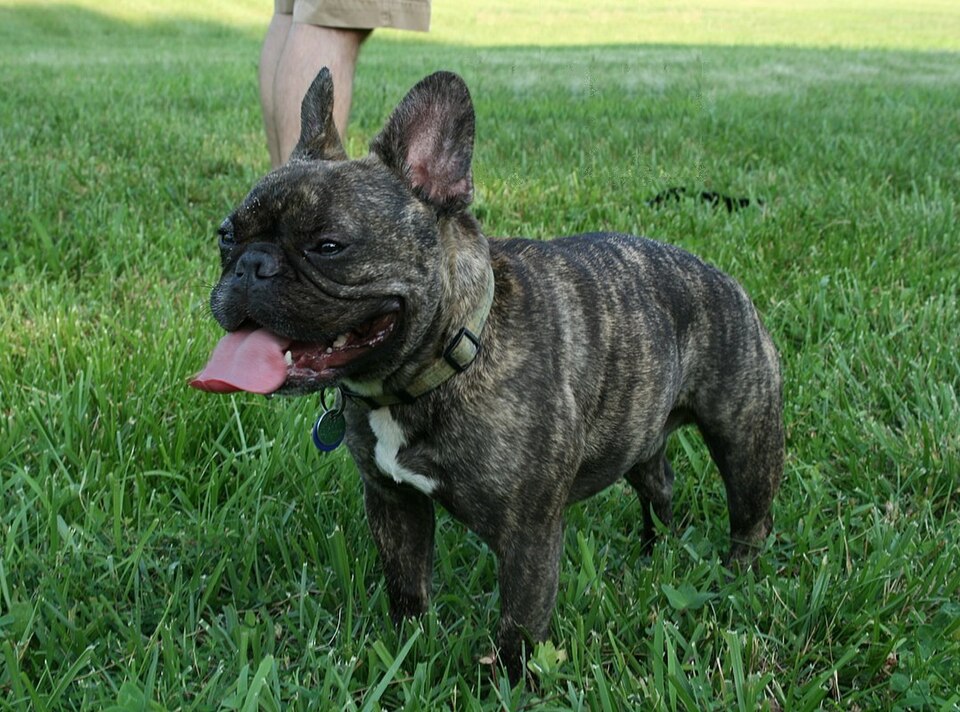
French Bulldogs are compact companion dogs with bat-like ears and a short muzzle. They are affectionate and adaptable to small homes, but their flat-faced build makes them sensitive to heat and strenuous exercise.
- Affectionate
- Playful
- Adaptable
Last reviewed: October 7, 2026
Key facts
| Origin | France |
|---|---|
| Size | Small |
| Adult weight | 8–14 kg |
| Life expectancy | 10–12 years |
| Height at withers (FCI) | Male 27–35 cm, female 24–32 cm (±1 cm) |
| Weight by sex (FCI) | Male 9–14 kg, female 8–13 kg |
| Accepted colours | Fawn or brindle, with or without white |
| Life expectancy at birth (UK study) | 4.5 years on average (see Health) |
Typical ranges; individuals vary.
Care and needs
Short walks, cool environments and a harness rather than a collar are commonly recommended. Clean facial folds regularly.
Good to know
Brachycephalic (flat-faced) breed: ask a vet about breathing before adopting and avoid exercise in hot weather.
This is general information. For your own animal’s health, ask a vet.
At a glance
- Energy
- Exercise needs
- Grooming
- Shedding
- Family-friendly
- With other pets
- Apartment-friendly
- Trainability
- Copes with time alone
- Vocal
PawShorts editorial estimates (1–5), not measurements. Use them to compare breeds with each other.
Size, weight and colours: what the standard says
The French Bulldog is a French breed: according to the FCI standard (No. 101, published 10 August 2023), it came from crosses made by breeders in the working-class districts of Paris in the 1880s, and the French kennel club (Société Centrale Canine) recognised it in 1898. The standard describes a small, powerful, cobby molossoid with a short coat and a short face, and its temperament as sociable, cheerful, playful, possessive and alert.
The standard sets measurements by sex. Male: 27 to 35 cm at the withers and 9 to 14 kg. Female: 24 to 32 cm and 8 to 13 kg. A 1 cm tolerance applies to height, and 500 g above the maximum weight if the dog is typical of the breed.
Only fawn and brindle coats are accepted, solid or with white patches (pied). Black, black and tan and all dilutions of black, such as blue, are non-standard colours that disqualify a dog in the show ring. An all-white dog is accepted but not sought after because of the risk of deafness. The nose must always be black.
Breathing and heat: the main risk
Its short face exposes the French Bulldog to brachycephalic obstructive airway syndrome (BOAS): narrow nostrils, an overlong soft palate and crowded airways. Signs range from snoring and quick tiring during exercise to serious collapse. In a University of Cambridge study of 604 dogs from three flat-faced breeds, narrow nostrils were associated with BOAS in every breed (Liu et al., 2017).
The standard itself requires nostrils that allow normal nasal breathing and disqualifies dogs with fully closed nostrils or in respiratory distress.
In the UK, the French Bulldog is among the breeds most at risk of heatstroke (Hall et al., 2020). In another study, the median outdoor temperature on heatstroke days was only 16.9 °C, and flat-faced dogs were more likely to die from it (Hall et al., 2022). In warm weather, keep it cool and calm, and never leave it in a car.
Other health problems and life expectancy
Among 2,228 French Bulldogs under veterinary care in the UK in 2013, 72% had at least one health problem recorded during the year. The most common were otitis externa (14%), diarrhoea (7.5%), conjunctivitis (3.2%), overlong nails (3.1%) and skin fold dermatitis (3%) (O’Neill et al., 2018). This population was young, with a median age of 1.3 years.
Compared with other dogs, French Bulldogs had higher odds for 20 of 43 common disorders studied, including narrow nostrils (about 42 times the odds), BOAS (about 31 times), ear discharge, skin fold dermatitis and difficult births. They had lower odds for 11 of those disorders (O’Neill et al., 2021).
In a UK study of 30,563 dogs that died between 2016 and 2020, the French Bulldog had the shortest life expectancy at birth of the breeds analysed: 4.53 years on average (95% confidence interval 4.14–5.01), against 11.23 years for dogs overall (Teng et al., 2022). Because the breed became very popular only recently in the UK, read this figure with caution; the 10–12 year range above is a typical lifespan for a dog that reaches adulthood.
Drawbacks to know before you commit
Affectionate and happy in a flat, the French Bulldog also comes with real constraints:
- Breathing is often compromised and heat sensitivity is high, which limits exercise and calls for care in summer.
- Vet costs to plan for: ears, skin, eyes, and sometimes airway surgery.
- Facial folds need regular cleaning.
- Short average life expectancy in the large UK study (see above).
- A temperament the standard itself describes as possessive.
Before buying or adopting a French Bulldog
In France, only a dog registered in the French pedigree book (LOF), kept by the Société Centrale Canine, can be sold as a pedigree dog (Rural Code, article L214-8). Blue, black or black and tan coats are not standard colours.
We do not give prices: they vary by breeder and we have no reliable, current source. Here is what to ask:
- How do the parents breathe at rest and after exercise? Loud snoring or quick breathlessness are warning signs.
- Have the parents had a vet assessment of their breathing? In the UK, the Royal Kennel Club and the University of Cambridge run a 0 to 3 grading after 3 minutes of exercise.
- The pedigree, the vet certificate and the puppy’s identification.
- Consider shelters and rescues too, where adult French Bulldogs look for new homes.
This is general information. For your own animal’s health, ask a vet.
French Bulldog photos


Videos featuring a French Bulldog

Next steps
Frequently asked questions
How much does an adult French Bulldog weigh?
Usually between 8–14 kg as an adult. Sex, lines and lifestyle all make a difference: your vet can tell you your own pet’s healthy weight.
Is a French Bulldog good for an apartment?
Generally yes: we rate its apartment fit as very high, as long as its exercise needs (low) are met.
Can a French Bulldog be left alone?
This needs planning: we rate its tolerance of time alone as moderate. Arrange walkers, sitters or company if you are out for long periods.
How big is a male or female French Bulldog?
Under the FCI standard, males are 27 to 35 cm at the withers and 9 to 14 kg, females 24 to 32 cm and 8 to 13 kg, with a 1 cm tolerance on height.
Is a blue or black French Bulldog purebred?
These colours are not in the FCI standard: black, black and tan and dilutions of black such as blue disqualify a dog in the show ring. Only fawn and brindle, with or without white, are accepted.
Why do French Bulldogs snore?
Their short face narrows the airways. Loud snoring, especially with breathlessness or quick tiring, can be a sign of brachycephalic obstructive airway syndrome (BOAS): talk to your vet.
How long do French Bulldogs live?
Typical ranges are 10 to 12 years for a dog that reaches adulthood. In a large UK study (Teng et al., 2022), average life expectancy at birth was only 4.53 years, the shortest of the breeds analysed.
What are the downsides of a French Bulldog?
Mainly breathing problems and heat sensitivity, frequent ear, skin and eye problems, and vet costs to plan for.
Similar breeds

Shih Tzu
Outgoing · Affectionate · Calm

Cavalier King Charles Spaniel
Gentle · Affectionate · Adaptable
Dachshund
Bold · Stubborn · Lively
Sources and review
- Breed reference: American Kennel Club
- Wikidata entry: Q29149
- FCI, Standard n° 101 Bouledogue français (18.09.2023)
- O’Neill D.G. et al. (2018), Canine Genetics and Epidemiology 5:3, French Bulldogs under primary veterinary care in the UK
- O’Neill D.G. et al. (2021), Canine Medicine and Genetics, French Bulldogs differ to other dogs in propensity for many common disorders
- Teng K.T. et al. (2022), Scientific Reports, life tables for companion dogs in the UK
- Liu N.C. et al. (2017), PLoS ONE, conformational risk factors of BOAS
- Hall E.J. et al. (2020), Scientific Reports, heat-related illness in UK dogs
- Hall E.J. et al. (2022), Veterinary Sciences, risk factors for severe and fatal heat-related illness
- Royal Kennel Club, Respiratory Function Grading scheme
- Société Centrale Canine, Livre des origines français (LOF)
- In-depth content updated: November 18, 2026
- Last reviewed: October 7, 2026