Cat · Thailand
Siamese cat
Siamese cats originate from Thailand and are known for their colour-point coat, blue eyes and talkative nature.
- Vocal
- Social
- Clever
Last reviewed: October 7, 2026
Key facts
| Origin | Thailand |
|---|---|
| Size | Medium |
| Size (FIFe standard) | Medium, svelte and elegant |
| Eye colour (FIFe) | Intense deep blue only |
| Life expectancy at birth (UK study) | 11.7 years (see Health) |
Typical ranges; individuals vary.
Care and needs
Minimal grooming; needs daily interaction and play.
Good to know
Very vocal and demanding of attention.
This is general information. For your own animal’s health, ask a vet.
At a glance
- Energy
- Exercise needs
- Grooming
- Shedding
- Family-friendly
- With other pets
- Apartment-friendly
- Trainability
- Copes with time alone
- Vocal
PawShorts editorial estimates (1–5), not measurements. Use them to compare breeds with each other.
What the standard says: colourpoint coat, blue eyes and wedge head
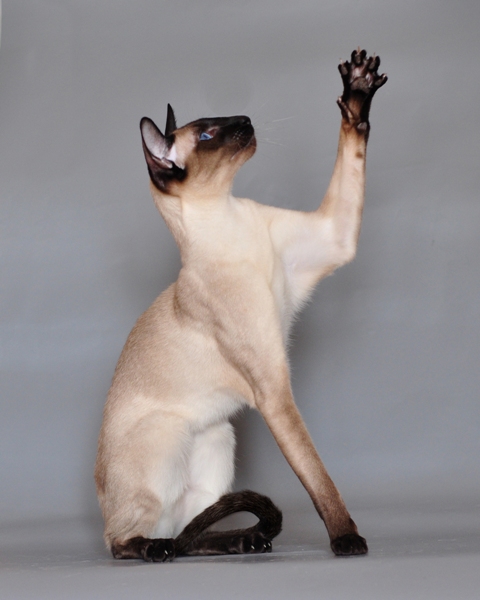
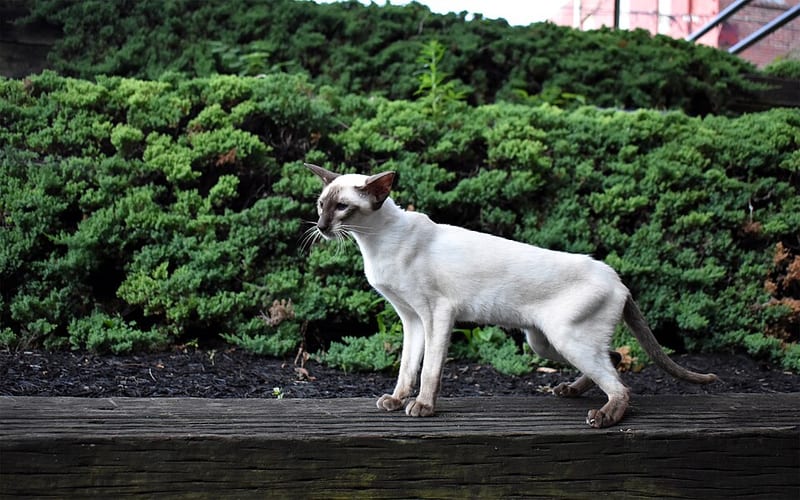
FIFe recognised the Siamese in 1949. Its standard (version of 1 January 2026), shared with the Balinese and the Orientals, describes a medium-sized, svelte and elegant cat with long tapering lines, supple and well muscled. The body is long and slender, the shoulders no wider than the hips, the legs long and fine and the tail very long, tapering to a fine point.
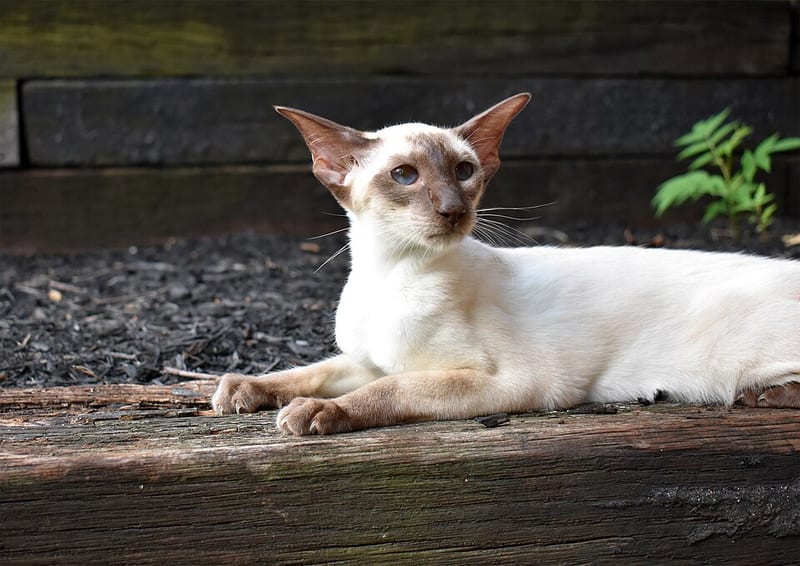
The head is a wedge with straight lines, a long straight nose without a break and large pointed ears, wide at the base, continuing the wedge. The almond eyes must be an intense deep blue: any other eye colour disqualifies.
The coat is very short, fine, glossy, silky and close-lying, with almost no undercoat. The pattern is “colourpoint”: the face mask, ears, legs and tail are darker than the body, with a clear contrast. The standard gives no weight.
How much does a Siamese weigh?
We found no measured weight specific to the Siamese. In a German study of pedigree cats weighed at ideal body condition, the Siamese and Oriental Shorthair were classed among the “very light” breeds. In that class, females averaged 2.8 kg and males 3.6 kg (Kienzle & Moik, 2011). This is a group average, not a Siamese-specific figure.
What is a Siamese’s temperament like?
The FIFe standard does not describe temperament. A large Finnish owner survey (5,726 cats) grouped the Siamese with the Orientals, Balinese and Seychellois. This group was among the most likely to seek human contact, but also among those most often showing excessive grooming and an owner-reported behaviour problem (Salonen et al., 2019). These results cover the whole group, not the Siamese alone.
Health: what the studies show
Eyes. The colourpoint pattern comes from a temperature-sensitive mutation in the tyrosinase gene (TYR): pigment forms mainly on the cooler parts of the body (Lyons et al., 2005). The same gene alters the routing of optic nerve fibres, and strabismus is common in the Siamese (McCormack, 1975). A progressive retinal atrophy (rdAc) leading to blindness also affects the breed: about a third of gene copies carried the mutation in the North American and European Siamese studied (Menotti-Raymond et al., 2010). A DNA test exists.
Amyloidosis. Of 194 Siamese and Oriental cats examined after death, 12 (6.2%) had amyloidosis, with pedigrees suggesting a familial trait (van der Linde-Sipman et al., 1997). In the Siamese, deposits mainly affect the liver (Niewold et al., 1999), and affected cats die between 1 and 7 years of age (Esders et al., 2023).
Breathing and cancer. The Siamese is overrepresented among cats with asthma or chronic bronchitis (Moise et al., 1989). In a UK series of 55 mediastinal lymphomas, 12 cats (21.8%) were Siamese, with a median age of 3 years (Fabrizio et al., 2014).
Life expectancy. In the UK, the Siamese has a life expectancy at birth of 11.7 years, close to that of crossbred cats (11.9 years) (Teng et al., 2024, 88 deaths). An older study gave a median lifespan of 14.2 years, but from only 31 cats (O’Neill et al., 2015). The two figures do not measure the same thing.
Drawbacks to know before you commit
The Siamese does not suit every home:
- It seeks a lot of contact: long daily absences are best avoided.
- Excessive grooming and other behaviour problems are reported more often in its breed group.
- Several diseases described in the breed (retinal atrophy, amyloidosis, asthma, mediastinal lymphoma).
Before buying or adopting a Siamese
In France, only a cat registered with the LOOF can be sold as a pedigree cat (Rural Code, article L214-8). We do not give prices, for lack of a reliable, current source. Here is what to ask:
- The parents’ DNA test results for retinal atrophy (rdAc).
- The known health history of the line, especially liver, kidneys and breathing.
- The pedigree, the vet certificate and the kitten’s identification. Consider shelters too.
This is general information. For your own animal’s health, ask a vet.
Siamese photos
Next steps
Frequently asked questions
Is a Siamese good for an apartment?
Generally yes: we rate its apartment fit as high, as long as its exercise needs (moderate) are met.
Can a Siamese be left alone?
This needs planning: we rate its tolerance of time alone as very low. Arrange walkers, sitters or company if you are out for long periods.
Why does the Siamese have darker extremities?
Its colourpoint pattern comes from a temperature-sensitive TYR gene mutation: pigment forms mainly on cooler areas such as the face, ears, legs and tail (Lyons et al., 2005).
Can a Siamese have green eyes?
Not under the FIFe standard: the eyes must be an intense deep blue, and any other colour disqualifies.
How long do Siamese cats live?
11.7 years at birth in the UK (Teng et al., 2024), close to crossbred cats. A smaller study gave a median lifespan of 14.2 years (O’Neill et al., 2015).
Do Siamese cats have inherited health problems?
Several have been described: retinal atrophy (rdAc, screenable by DNA test), amyloidosis mainly affecting the liver, and overrepresentation in asthma and mediastinal lymphoma.
Similar breeds
Sources and review
- Breed reference: Cat Fanciers’ Association, Siamese breed page
- Wikidata entry: Q42604
- FIFe, Balinese/Siamese/Oriental (BAL-SIA-OLH-OSH) breed standard, version 01.01.2026
- Kienzle E., Moik K. (2011), British Journal of Nutrition 106(S1), body weight of pure-bred adult cats
- Salonen M. et al. (2019), Scientific Reports, breed differences of heritable behaviour traits in cats
- Lyons L.A. et al. (2005), Animal Genetics, tyrosinase mutations and Siamese/Burmese colouration
- McCormack G.L. (1975), Investigative Ophthalmology, optic chiasm and strabismus in Siamese cats
- Menotti-Raymond M. et al. (2010), The Veterinary Journal, rdAc mutation across cat breeds
- van der Linde-Sipman J.S. et al. (1997), Veterinary Immunology and Immunopathology, amyloidosis in Siamese and Oriental cats
- Niewold T.A. et al. (1999), Amyloid, familial amyloidosis in Siamese cats
- Esders S.L. et al. (2023), Genes, AA amyloidosis in Siamese and Oriental cats
- Moise N.S. et al. (1989), JAVMA, bronchopulmonary disease in cats
- Fabrizio F. et al. (2014), Journal of Feline Medicine and Surgery, feline mediastinal lymphoma
- Teng K.T. et al. (2024), Journal of Feline Medicine and Surgery, life tables for companion cats in the UK
- O’Neill D.G. et al. (2015), Journal of Feline Medicine and Surgery, longevity and mortality of cats in England
- LOOF, Livre officiel des origines félines
- In-depth content updated: November 18, 2026
- Last reviewed: October 7, 2026